In this article
Key takeaways
- Four agents connect document intake, client facts, bank work and monthly review.
- The accounting engine carries supported work through posting and reconciliation.
- Measure capacity through complete months, including questions and corrections.
The work between receiving a file and finishing the month
Consider a supplier invoice. Reading its total is one step. The month still needs the correct legal supplier, account, VAT treatment and period. The payment may settle only part of it, include another invoice or deduct agreed cash discount. A missing document or unexplained difference can hold up the rest.
If these steps remain disconnected, staff repeatedly reopen the same case. Hans keeps the document, business facts, accounting entry and settlement together, so the next step can use the work already done.
That is why the product covers the whole monthly process.
Four agents, connected to the accounting work
| Agent | Work across the month | Useful result for the firm |
|---|---|---|
| Document intake agent | Reads and classifies invoices, receipts, contracts and supported statements; extracts fields and works with reusable templates | Usable records with source evidence |
| Client agent | Investigates missing counterparty or contract details and helps obtain specific business facts | Answers attached to the transaction |
| Bank agent | Investigates references, allocates payments and supports settlement of partial payments, batches, advances and differences | Explained bank movements and remaining balances |
| Accountant agent | Examines journals, balances and workpapers, investigates discrepancies and supports corrections and repeated review | Findings that can be resolved before close |
The agents work with the accounting engine: balanced entries, SKR03 accounts, configured VAT timing, reverse charge, foreign-currency treatment and settlement rules. AI helps interpret and investigate. Defined accounting logic calculates the recorded effects.
Automation and review follow the client's setup and the firm's permissions. The firm can inspect the result and the evidence behind it.
More of the routine month can be completed
The practical scope includes several kinds of work that otherwise land on a preparer's desk:
- Documents: identify duplicates, separate invoices from supporting pages and connect corrections to the original transaction.
- Counterparties: identify or create suppliers and customers and preserve their account relationships.
- Contracts: use supported recurring contract information alongside invoices and payments.
- Payments: allocate one payment to several invoices, account for partial settlement and investigate unmatched amounts.
- Differences: handle evidenced cash discounts, write-offs and exchange differences under the configured rules.
- Direct bank entries: process identified movements such as payroll or tax payments against defined accounts.
- Month end: reconcile balances, resolve findings, review the books and produce the closing outputs.
The AI bookkeeping guide demonstrates the chain with actual entries and amounts. The monthly review walkthrough follows a discrepancy through correction and close.
Ask the client for facts they know
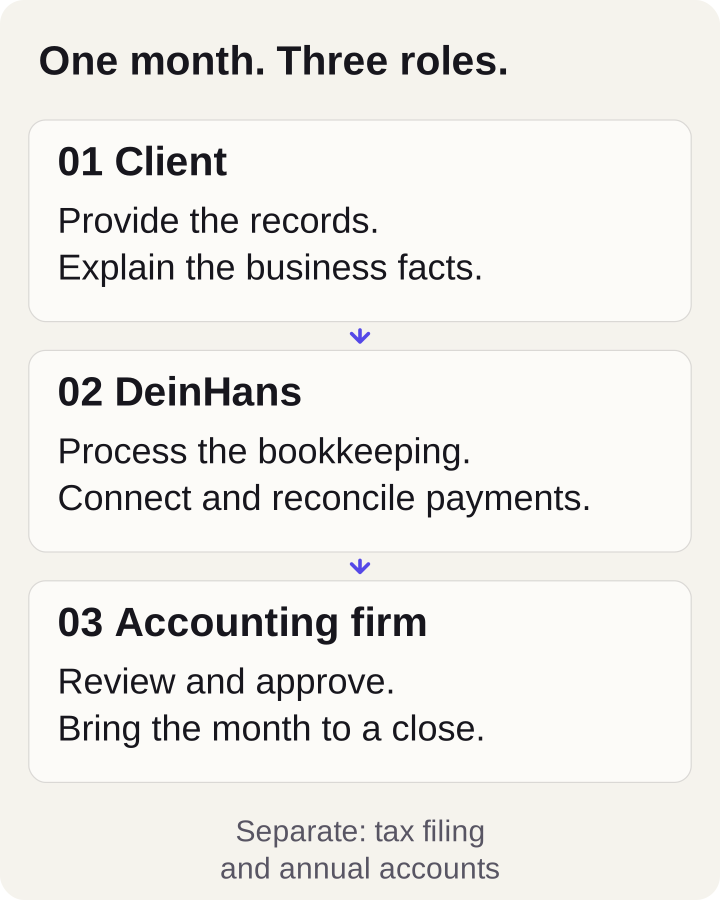
A client can explain who used a purchase, provide a missing invoice or confirm what a payment was for. They should not have to choose a VAT key to keep the process moving.
For example, a director has personally paid a company expense. Hans needs the invoice and the payment facts. The accounting treatment then distinguishes the supplier settlement from the amount owed to the director. The firm's review can begin with that complete case.
This division removes repeated clarification work while retaining the firm's professional decisions.
Finished books that fit the firm's workflow
After the required review, the monthly output includes journal entries, connected evidence, reconciliations, a trial balance and a management report. The export engine provides the DATEV package and configurable CSV profiles for Agenda FIBU, Lexware buchhaltung and other agreed CSV workflows.
The firm confirms target accounts, tax keys and import results. Direct DATEV integration is planned. Payroll calculation, statutory filing and annual accounts remain distinct services where the engagement requires them.
Measure capacity in completed months
Use one representative client month and record the firm's time across intake, questions, posting, review, corrections and import checks. Include all recurring work; keep one-time setup separate.
A simple planning calculation makes the opportunity visible:
| Illustrative monthly capacity | Before | After a measured improvement |
|---|---|---|
| Team hours available for these clients | 60 | 60 |
| Average firm time per completed client month | 1.5 hours | 0.75 hours |
| Completed client months within those hours | 40 | 80 |
These are planning figures, not measured Hans customer results or a performance promise. Substitute your own observed times, including difficult cases and rework.
We want Hans to make accepting the next suitable mandate a realistic decision for a small firm. The first proof is a completed month with fewer recurring interventions. The next is whether that improvement holds across the firm's clients.
Sources
Sources were checked on 06 October 2026. This article provides orientation and is not tax, legal, or accounting advice.