Open table of contents
Key takeaways
- The monthly package connects evidence, payments and bookkeeping results.
- Month-wide preparation can resolve relationships that were unclear when the first document arrived.
- A review signal explains the issue; the firm's policy determines the required attention.
- Collective confirmation is still an accountant action for eligible proposals.
What work remains for the accountant?
That is the question we hear when discussing bookkeeping automation. A tool can read documents quickly and still leave the firm to find missing context, explain differences and reconstruct payment relationships.
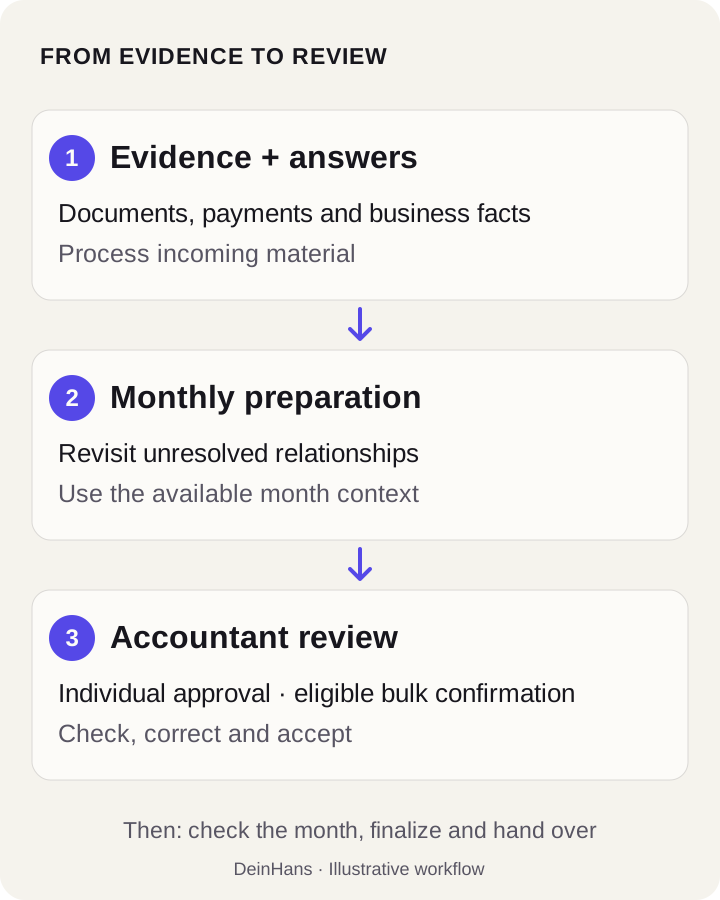
We designed DeinHans around a monthly package to reduce that repeated preparation. The accountant should start with connected work and clear decisions, then assess, correct and accept the result.
First, process the incoming evidence
The business provides records through the agreed routes, such as uploads or an enabled document inbox. Supported invoices, bank statements, payout reports and contracts enter the same monthly context. Rules and AI help interpret the evidence and prepare the corresponding bookkeeping; actual file and workflow support still matters.
When a business fact is missing, the owner receives a question they can answer. What was an unexplained transfer for? Was the purchase personal? Did a shareholder provide money to the company? Their answer and supporting records help establish the event. Accounting treatment remains a separate assessment.
Consider a contract starting in January 2026 when bookkeeping in DeinHans begins in September. Earlier occurrences need an explicit decision about historical catch-up. Check what was already recorded, inspect the selected occurrences and retain their original dates. Any permitted catch-up requires an eligible open posting period. Pre-start history is optional work; it does not automatically block September or silently reopen closed periods.
Then use the month's fuller picture
As documents arrive, an unresolved payment may gain an invoice, or a credit note may explain a short payment. Before the accountant's review workspace is published, monthly preparation revisits unresolved work for the selected client, period and intake cutoff.
Take these fictional examples:
| Evidence available | What must be established | Result when supported |
|---|---|---|
| €1,200 invoice, €200 related credit note, payments of €400 and €600 | The credit and both payments belong to this liability | €1,200 − €200 − €400 − €600 = €0 remaining |
| Invoices of €450 and €650, one €1,100 payment | The payment covers both invoices | Both amounts are settled without creating another expense |
Matching totals alone are insufficient. Supplier identity, references, currency and remaining amounts must support the relationship. An advance payment needs evidence connecting it to the later invoice. Ambiguous work stays visible for review.
Inspect the result beside its evidence
For the €1,200 example, the accountant can follow a connected case:
| Review item | What it explains |
|---|---|
| Invoice and supplier | The source and identity behind the €1,200 liability |
| Related €200 credit note | Why the amount payable decreased |
| €400 and €600 bank payments | Which movements settled the remaining amount |
| Bookkeeping lines and balance | How the proposed result compares with the evidence |
| Current review reason | What still needs a decision |
This is an illustrative evidence map, not a customer screenshot or measured result. Later evidence belongs in an explicit revised handover so the review basis stays understandable.
A retained, readable document without a usable proposal can also reach the accountant for manual preparation after automatic recovery attempts are exhausted. Its technical diagnosis stays separate, and a valid proposal must exist before approval. Failures preventing evidence access or a valid handover still need recovery.
Individual approval and collective confirmation
Pending approval contains cases requiring an individual decision. The accountant opens the case, compares the source with the proposed entry and takes the available action: approve, edit, create a valid proposal, or use the appropriate exclusion or correction.
Excluding a case does not erase a real bank movement. Allocated payments and posted entries need their supported correction paths.
Pending confirmation contains valid proposals eligible for collective handling under the current policy. The accountant can inspect them individually, select several or confirm all currently eligible cases. Individual-approval cases cannot join that action simply because everything was selected.
The firm starts with configured review rules and can adapt supported controls for its practice, relevant client groups or a particular client. The signal describes the issue. The policy organizes the review; it does not decide tax law.
How an illustrative €100 threshold works
Suppose the firm sets individual approval with a €100 minimum for “Document VAT differs from the proposal.” This is an example configuration, not the product's universal default or a recommended tax materiality limit.
For an invoice, the comparison uses the gross case amount, not the VAT amount or the VAT difference.
| Gross case amount | Route under this example policy |
|---|---|
| €50 | Pending confirmation, if valid and otherwise eligible |
| €100 | Pending approval: the minimum includes exactly €100 |
| €150 | Pending approval |
Another review reason can still require individual approval for €50. Cases without a valid proposal and explicit requests for an accountant decision retain mandatory individual-review boundaries. A visible signal also remains on a case eligible for collective confirmation.
A VAT difference still needs the right treatment
In supported purchase cases, missing evidence can lead to a proposal without input-VAT deduction and with a review reason. This is not a general rule that a lower VAT number is safer. Input deduction has legal conditions; output VAT and reverse charge require their own assessment. Section 15 UStG.
DATEV also provides proposal certainty indicators and calls for review when using automatic posting. DeinHans's focus here is how those decisions fit into a connected monthly process. DATEV Automatisierungsservice Rechnungen.
The accountant's final checklist
- Confirm scope: client, period, included evidence and unresolved recovery issues.
- Resolve individual cases: inspect, correct or approve with the supporting records.
- Confirm eligible routine work: individually or collectively under the firm's procedure.
- Check the month: balances, allocations and outstanding positions, including contributions from other systems.
- Finalize and hand over: approval, posting, finalization, export and receiving-system acceptance remain distinct steps.
The purpose is less avoidable reconstruction: finding the invoice behind a payment, repeating an established allocation or asking for an answer already attached to the case.
Could several hours become half an hour?
For a suitable client, my ambition is to turn five or six hours of manual bookkeeping into a much shorter focused review, perhaps half an hour. That is a design objective, not a measured customer result or a promise for every month.
Measure the entire process: preparation, owner questions, individual review, collective confirmation, corrections and handoff. Separate initial setup from recurring work and compare similar volumes across several months. Thirty minutes in a review screen is useful only if it reduces the total work at the firm's chosen standard.
Start by following one payment to its evidence and testing one case on each side of your chosen review threshold. That makes the workflow concrete before you extend automation. For setup and posting ownership, see using DeinHans alongside DATEV.
Sources
Sources were checked on 24 September 2026. This article provides orientation and is not tax, legal, or accounting advice.
Related resources
See how your firm would review a month
Inspect a monthly package with us: evidence, payments and remaining decisions. Establish what stays in your existing workflow and what DeinHans takes on.
Inspect a monthly package in a demo