Open table of contents
Key takeaways
- Owners answer business questions without choosing account codes or tax treatments.
- DeinHans connects the evidence and produces the bookkeeping for the agreed scope.
- The firm reviews the result with its sources, explanations and remaining questions.
- Start with one client month and compare the total preparation, review and handoff effort.
Why we built another bookkeeping tool
Germany has capable financial software and experienced accounting firms. An owner can use DATEV Unternehmen online, work in Lexware Office and send documents digitally. Access to software is rarely the whole problem.
The difficulty often starts where responsibilities meet. An owner comfortably creates invoices and explains purchases, then encounters a foreign invoice, a payout with several deductions or a complicated card statement. They know the business event but may not know how to book it.
The unresolved work then travels by email, WhatsApp or a phone call. The accountant receives the information, but someone still has to connect it to the right document, payment and month.
That is the work I wanted DeinHans to remove: rebuilding the context before the actual accounting review can begin. A useful additional tool should make the relationship easier for both sides.
What does DeinHans add beside DATEV or Lexware Office?
DATEV already supports digital collaboration, and Lexware Office offers different DATEV exports according to the agreed division of work. DeinHans builds on that reality. Its role is to produce a connected monthly result from business evidence and make the unresolved decisions explicit. DATEV digital collaboration, Lexware Office DATEV exports.
The practical questions are simple: who obtains missing facts, where do the answers stay, and what does the accountant receive? DeinHans should improve the work that remains in your current arrangement. The guide to starting alongside DATEV explains the setup and handoff in more detail.
Ask the owner about the business event
An owner can usually explain what was purchased, who used it and which project it supported. They may be unsure about deductibility, the right account or a VAT treatment. Asking for those decisions can turn a simple clarification into a stressful accounting exercise.
We separate the factual question from the resulting treatment:
| Situation | What the business can explain | What still needs accounting assessment |
|---|---|---|
| Unclear bank payment | What was bought, for whom, and where is the document? | The supported treatment and any unresolved professional issue |
| Possible personal use | Who used it, for what purpose, and was any part personal? | The accounting consequence; “business-related” alone does not establish deductibility |
| Foreign supplier invoice | What was supplied and which business received it? | The relevant tax treatment, including any reverse-charge question |
| Payout below the reported activity | Which report and payout does this receipt belong to? | How its components connect and what remains unexplained |
These are workflow examples, not tax conclusions. The owner can answer accurately, including “I don't know,” without pretending to be an accountant.
Three roles, one connected month
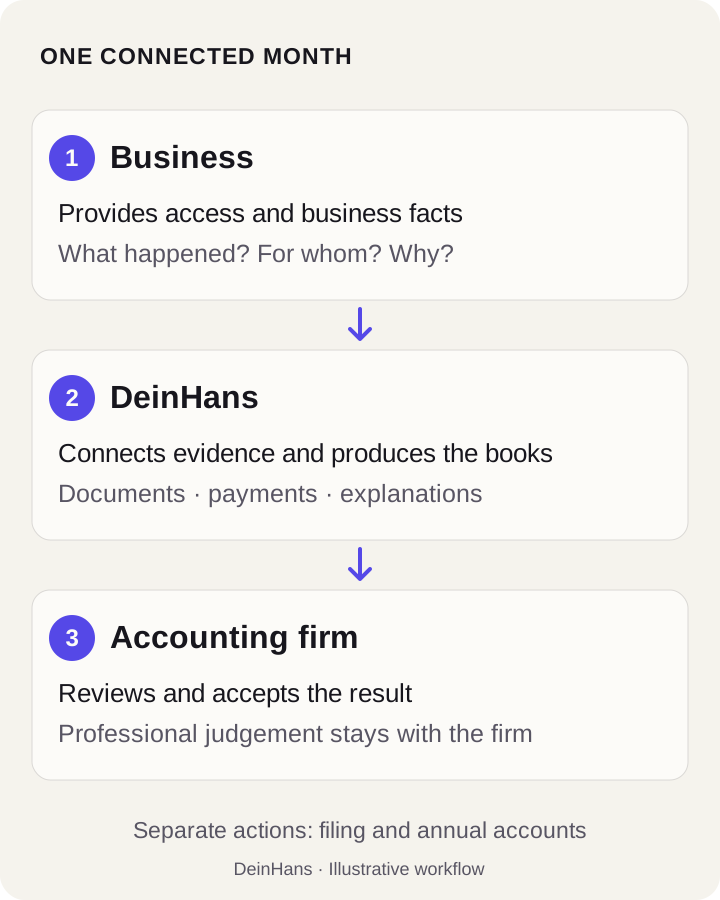
DeinHans is our bookkeeping engine. It collects and connects relevant evidence, produces the bookkeeping, reconciles supported flows and makes remaining questions visible. The owner's answer stays with the case it explains.
The accounting firm controls professional review and acceptance. A question requiring judgement arrives with its evidence and context. It should not become an unexplained warning or an accounting decision pushed back to the owner.
Final monthly books means the completed bookkeeping output for the agreed, supported scope. Professional acceptance, tax filing and annual accounts remain separate actions under the firm's engagement.
This also prevents duplicated work. If the owner already issues invoices elsewhere, agree which records exist, what DeinHans contributes and how the firm will receive the combined result.
A fuel-card file shows why context matters
Imagine a multi-page file containing a fuel-card transaction list, a separate service-fee invoice and a settlement summary. One bank debit relates to the package. This is a fictional example, but a useful test of bookkeeping automation.
Accurately reading the amounts still leaves questions. Which pages are invoices? Which provide supporting detail? Does the fee invoice cover only the service charge? Has the underlying activity already been recorded?
Taking the largest total as one fuel invoice could miss the distinction. Recording every repeated amount as a new expense could duplicate it. The useful result preserves each document's role and connects it to the payment.
Bring your actual format to an evaluation and inspect both the proposed result and the unresolved parts. Support for one layout does not establish automatic support for every fuel-card package.
What makes the result easier to trust?
A reviewer needs the source, the business explanation, the accounting effect, the payment relationship and the reason for attention together. That context makes it easier to accept, correct or investigate a case.
Review signals also exist in other tools: DATEV documents indicators for uncertain or incomplete booking proposals. The value we seek is a coherent handoff across the whole month. A signal organizes attention; an unflagged item still remains subject to the firm's review requirements. DATEV review indicators.
See the monthly-review walkthrough for individual approval, collective confirmation and a worked payment example.
Evaluate one representative client month
- Name the remaining work. Identify missing explanations, mixed document packages and unresolved settlements in the current process.
- Agree the review input. Define the evidence, output and exception history the firm needs.
- Test the receiving workflow. Creating an export, importing it and accepting the books are separate results.
- Measure the whole effort. Include setup, clarification, review, corrections and handoff.
The commercial case for DeinHans is strongest when the firm spends less time reconstructing the month and more time on the decisions that need its expertise. That is also the reassurance we want to give the owner: explain the business clearly, without becoming its accountant.
Sources
Sources were checked on 24 September 2026. This article provides orientation and is not tax, legal, or accounting advice.
Related resources
See how your firm would review a month
Inspect a monthly package with us: evidence, payments and remaining decisions. Establish what stays in your existing workflow and what DeinHans takes on.
Inspect a monthly package in a demo